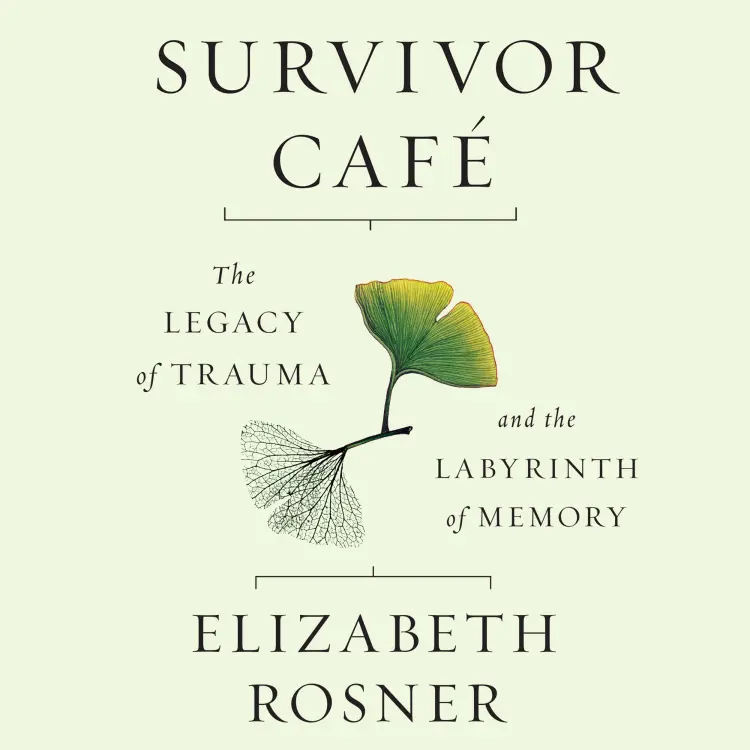
Survivor Café - The Legacy of Trauma and the Labyrinth of Memory
Elizabeth Rosner
Unabridged
9 horas 14 minutos
Nota: La reproducción de los audiolibros o de las obras de audio en las respectivas plataformas, por ejemplo Spotify, puede generar gastos. Lismio no tiene ninguna influencia sobre qué audiolibros y obras de audio están disponibles en el servicio.
Algunos artículos contienen enlaces de afiliados (marcados con un asterisco *). Si hace clic en estos enlaces y compra productos, recibiremos una pequeña comisión sin coste adicional para usted. Su apoyo ayuda a mantener este sitio en funcionamiento y a seguir creando contenidos útiles. Gracias por su apoyo.
De la editorial
As firsthand survivors of many of the twentieth century's most monumental events-the Holocaust, Pearl Harbor, the Killing Fields-begin to pass away, Survivor Café addresses urgent questions: How do we carry those stories forward? How do we collectively ensure that the horrors of the past are not forgotten?
Elizabeth Rosner organizes her book around three trips with her father to Buchenwald concentration camp-in 1983, in 1995, and in 2015-each journey an experience in which personal history confronts both commemoration and memorialization. She explores the echoes of similar legacies among descendants of African American slaves, descendants of Cambodian survivors of the Killing Fields, descendants of survivors of the bombing of Hiroshima and Nagasaki, and the effects of 9/11 on the general population. Examining current brain research, Rosner depicts the efforts to understand the intergenerational inheritance of trauma, as well as the intricacies of remembrance in the aftermath of atrocity. Survivor Café becomes a lens for numerous constructs of memory-from museums and commemorative sites to national reconciliation projects to small-group cross-cultural encounters.
Beyond preserving the firsthand testimonies of participants and witnesses, individuals and societies must continually take responsibility for learning the painful lessons of the past in order to offer hope for the future. Survivor Café offers a clear-eyed sense of the enormity of our twenty-first-century human inheritance-not only among direct descendants of the Holocaust but also in the shape of our collective responsibility to learn from tragedy, and to keep the ever-changing conversations alive between the past and the present.
Elizabeth Rosner organizes her book around three trips with her father to Buchenwald concentration camp-in 1983, in 1995, and in 2015-each journey an experience in which personal history confronts both commemoration and memorialization. She explores the echoes of similar legacies among descendants of African American slaves, descendants of Cambodian survivors of the Killing Fields, descendants of survivors of the bombing of Hiroshima and Nagasaki, and the effects of 9/11 on the general population. Examining current brain research, Rosner depicts the efforts to understand the intergenerational inheritance of trauma, as well as the intricacies of remembrance in the aftermath of atrocity. Survivor Café becomes a lens for numerous constructs of memory-from museums and commemorative sites to national reconciliation projects to small-group cross-cultural encounters.
Beyond preserving the firsthand testimonies of participants and witnesses, individuals and societies must continually take responsibility for learning the painful lessons of the past in order to offer hope for the future. Survivor Café offers a clear-eyed sense of the enormity of our twenty-first-century human inheritance-not only among direct descendants of the Holocaust but also in the shape of our collective responsibility to learn from tragedy, and to keep the ever-changing conversations alive between the past and the present.
Del mismo autor

Novel Audio
-
Cover - Elizabeth Howell - The Search for Life on Mars - The Greatest Scientific Detective Story of All Time
 Elizabeth Howell: The Search for Life on Mars - The Greatest Scientific Detective Story of All TimeThe Search for Life on Mars - The Greatest Scientific Detective Story of All TimeElizabeth Howell
 -
Cover - Harvey Karp - The Happiest Baby on the Block - The New Way to Calm Crying and Help Your Newborn Baby Sleep Longer
 Harvey Karp: The Happiest Baby on the Block - The New Way to Calm Crying and Help Your Newborn Baby Sleep LongerThe Happiest Baby on the Block - The New Way to Calm Crying and Help Your Newborn Baby Sleep LongerHarvey Karp
 -
Cover - Darryl Ponicsán - Last Flag Flying
 Darryl Ponicsán: Last Flag FlyingLast Flag FlyingDarryl Ponicsán
 -
Cover - Celia Kyle - Dragons of Preor - Book 2 - Taulan
 Celia Kyle: Dragons of Preor - Book 2 - TaulanSeriesDragons of Preor - Book 2 - TaulanCelia Kyle
 -
Cover - Gillian Zoe Segal - Getting There - A Book of Mentors
 Gillian Zoe Segal: Getting There - A Book of MentorsGetting There - A Book of MentorsGillian Zoe Segal
 -
Cover - Kandi Steiner - What He Doesn't Know Duet - Book 1 - What He Doesn't Know
 Kandi Steiner: What He Doesn't Know Duet - Book 1 - What He Doesn't KnowSeriesWhat He Doesn't Know Duet - Book 1 - What He Doesn't KnowKandi Steiner
 -
Cover - Jenna Fischer - The Actor's Life - A Survival Guide
 Jenna Fischer: The Actor's Life - A Survival GuideThe Actor's Life - A Survival GuideJenna Fischer