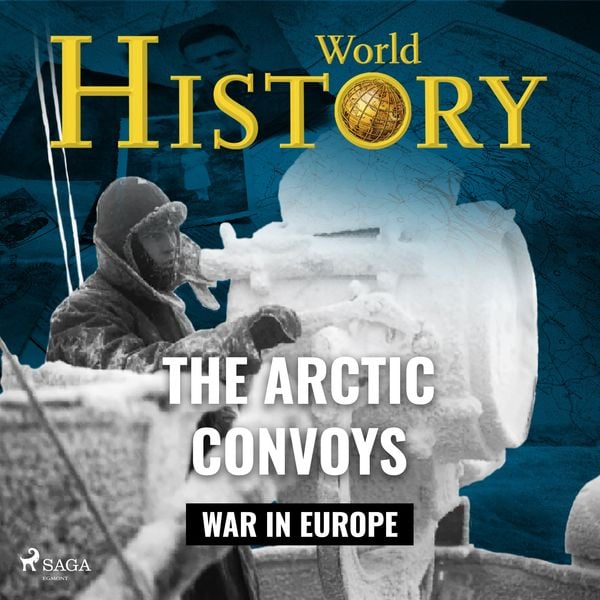
War in Europe
The Arctic Convoys
World History
Unabridged
•
9788728598702
3 hours 53 minutes

Some articles contain affiliate links (marked with an asterisk *). If you click on these links and purchase products, we will receive a small commission at no extra cost to you. Your support helps to keep this site running and to continue creating useful content. Thank you for your support!
From the publisher
As World War II raged across the Russian steppes, in Africa and especially in the skies over Europe, elite German and Soviet forces fought a bitter battle in an isolated northern corner of Europe. Here, the battle was for control of the ice-free port of Murmansk, where the Soviet Union received convoy after convoy loaded with British and American tanks, guns, fuel, small arms, food and aircraft. Supplies from the Allied convoys kept the Soviet Union alive at a critical time during the early stages of the war, and Hitler therefore tried every means to stop the convoys. At the beginning of the campaign against the Soviet Union, he hoped to capture Murmansk and thus weaken his archenemy. Later, when he realised that fighting in the barren, mountainous terrain of the north was unwinnable, he set his sights on destroying the convoys. The Luftwaffe and U-boats attacked the Allied sailors throughout the perpetual daylight of polar summer while crushing ice and raging storms threatened during the dark winter months. The men aboard the Arctic convoys dreaded the voyages, and it was with good reason that the crews dubbed them 'suicide convoys'. If they fell overboard in a storm, a quick death awaited them in the icy sea, and if the ships' holds, filled with fuel and ammunition, were hit by a torpedo or a bomb, everything exploded in a sea of flames. The Arctic convoy trips and the fighting on the Northern Front challenged some of the war's toughest men. Read their stories here.
From the same authors


Also included in

SAGA Egmont
-
Cover - R.A. Salvatore - Compilation Dungeons & Dragons 7-10 : ...
 R.A. Salvatore: Compilation Dungeons & Dragons 7-10 : ...SeriesCompilation Dungeons & Dragons 7-10 : ...R.A. Salvatore
 -
Cover - Karin Fossum - Schwarzer Wald
 Karin Fossum: Schwarzer WaldSeriesSchwarzer WaldKarin Fossum
 -
Cover - Emma Olofsson - Yhtä kuoleman edessä
 Emma Olofsson: Yhtä kuoleman edessäSeriesYhtä kuoleman edessäEmma Olofsson
 -
Cover - Ellinor Rafaelsen - För sista gången
 Ellinor Rafaelsen: För sista gångenSeriesFör sista gångenEllinor Rafaelsen
 -
Cover - Emma Ranta - Rakkauden uusi vuosi
 Emma Ranta: Rakkauden uusi vuosiRakkauden uusi vuosiEmma Ranta
 -
Cover - Ellinor Rafaelsen - Trollbunden
 Ellinor Rafaelsen: TrollbundenSeriesTrollbundenEllinor Rafaelsen