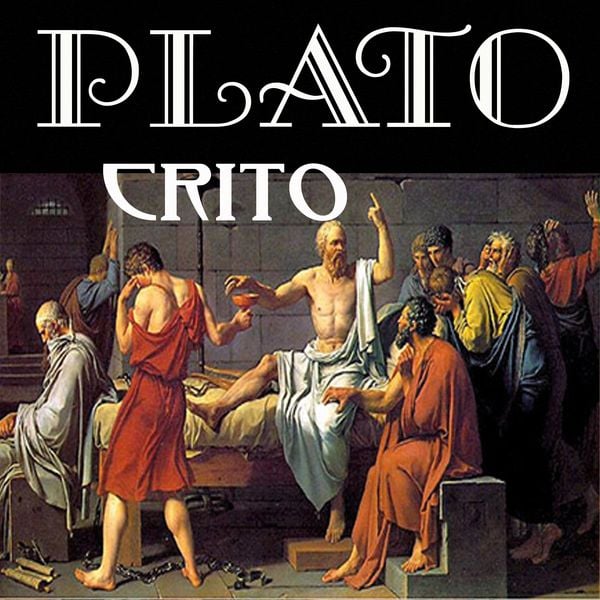
Crito
Plato
Unabridged
•
4099995462753
39 minutes

Some articles contain affiliate links (marked with an asterisk *). If you click on these links and purchase products, we will receive a small commission at no extra cost to you. Your support helps to keep this site running and to continue creating useful content. Thank you for your support!
From the publisher
Crito is a dialogue that was written by the ancient Greek philosopher Plato. It depicts a conversation between Socrates and his wealthy friend Crito of Alopece regarding justice, injustice, and the appropriate response to injustice after Socrates's imprisonment, which is chronicled in the Apology. In Crito, Socrates believes injustice may not be answered with injustice, personifies the Laws of Athens to prove this, and refuses Crito's offer to finance his escape from prison. The dialogue contains an ancient statement of the social contract theory of government. In contemporary discussions, the meaning of Crito is debated to determine whether it is a plea for unconditional obedience to the laws of a society. The text is one of the few Platonic dialogues that appear to be unaffected by Plato's opinions on the matter; it is dated to have been written around the same time as the Apology.
From the same authors


Strelbytskyy Multimedia Publishing
-
Cover - A. S. Pushkin - Baryishnya-krestyanka
 A. S. Pushkin: Baryishnya-krestyankaBaryishnya-krestyankaA. S. Pushkin
 -
Cover - Alexander Pushkin - Istoriya Pugachyova
 Alexander Pushkin: Istoriya PugachyovaIstoriya PugachyovaAlexander Pushkin
 -
Cover - Alexander Pushkin - Pesn' o veschem Olege
 Alexander Pushkin: Pesn' o veschem OlegePesn' o veschem OlegeAlexander Pushkin
 -
Cover - Taras Shevchenko - Kobzar. Za vydannyam 1840 roku taras ...
 Taras Shevchenko: Kobzar. Za vydannyam 1840 roku taras ...Kobzar. Za vydannyam 1840 roku taras ...Taras Shevchenko
 -
Cover - Alexander Pushkin - Roman v pismah
 Alexander Pushkin: Roman v pismahRoman v pismahAlexander Pushkin